The Clinic aims to provide the best possible management for persons with low vision.
What is Low vision?
Best corrected visual acuity of 6/18 or less and / or field of vision of 10 degree or less
In simple words…
People who are unable to see objects (say a person’s face) beyond maximum of 3m i.e., 10 feet distance (with their spectacle correction) and / or people those who have side vision difficulty are said to have low vision.
When ordinary eye glasses, contact lenses or intraocular lens implants cannot provide sharp sight, an individual is said to have low vision. Although reduced central or reading vision is common, low vision may also result from decreased side (peripheral) vision, a reduction or loss of clarity of vision, or the eye's inability to properly adjust to light or glare.
The Clinic helps in enhancing the existing potential vision of the patients
Difficulties dealt…
| |
Recognizing faces at distance |
| |
Watching TV |
| |
Seeing black board (for students) |
| |
Reading fine print / writing |
| |
Computer tasks / Mobile tasks |
| |
Glare problems |
Most common conditions seen in the clinic
| |
Congenital cataract / Aphakia |
| |
Retinitis Pigmentosa |
| |
Albinism |
| |
Diabetic retinopathy |
| |
Age related macular degeneration |
| |
Heredomacular degeneration (eg: Stargardt’s disease) |
| |
Glaucoma |
| |
Nystagmus |
| |
Optic nerve problems (eg: Optic atrophy) |
Services provided:
| |
Assessment of difficulty level of the patients in performing day-to-day activities |
| |
Vision assessment |
| |
Spectacle power check up |
| |
Testing with Low vision devices (optical and non-optical) |
| |
Color vision assessment |
| |
Contrast sensitivity assessment |
| |
Field of vision assessment |
Available Optical devices:
Devices for Near:
Telescopes:
| |
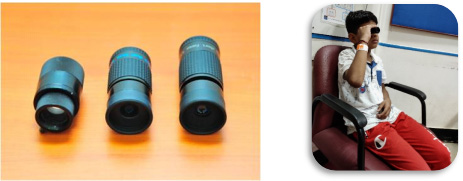
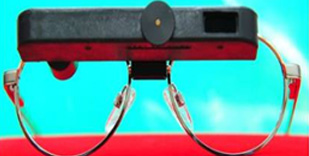
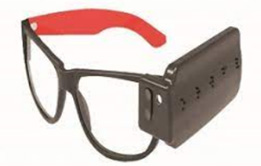
Monocular telescope (Hand held and Spectacle mounted) |
| |
Binocular telescope |
| |
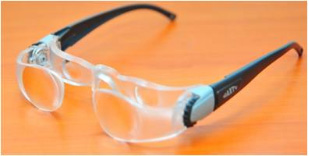
SEE TV (Spectacle model telescope) |
 |
|
 |
I. Monocular telescope
(Hand held and Spectacle mounted) |
|
II. Binocular telescope |
|
III. SEE TV (Spectacle model telescope) |
Devices for devices:
| |
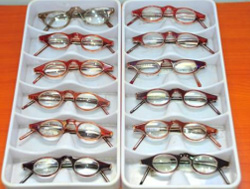
Spectacle magnifiers |
| |
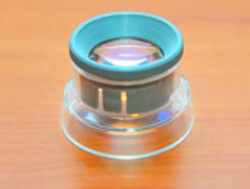
Stand magnifiers |
| |
Hand held magnifiers |
| |
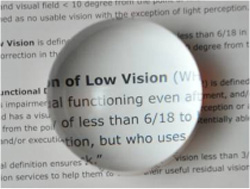
Dome magnifiers |
| |
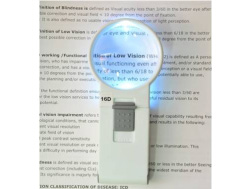
Fresnel book magnifiers |
 |
|
 |
| I. Spectacle magnifiers |
 |
|
 |
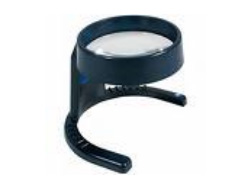
| II. Stand magnifiers |
|
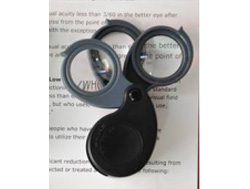
III. Hand held magnifiers |
 |
 |
| IV. Dome magnifiers |
V. Fresnel book magnifiers |
Available Non-optical devices:
| |
Notex |
| |
Typoscope |
| |
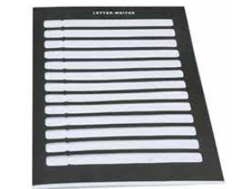
Letter writer |
| |
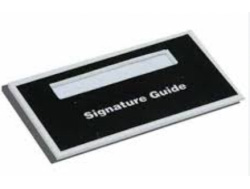
Signature guide |
| |
Talking watch |
 |
 |
 |
| III. Letter writer |
IV. Signature guide |
V. Talking watch |
Available computer softwares (for demonstration):
Reader software:
Magnification + Reader software:
Text scanning software:
Available Assistive devices:
| |
CCTV - Closed Circuit Tele Vision |
 |
 |
| I. Letter writer |
II. Signature guide |
 |
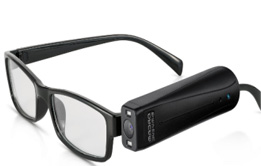
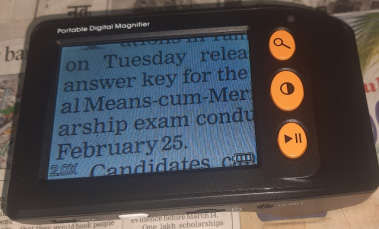
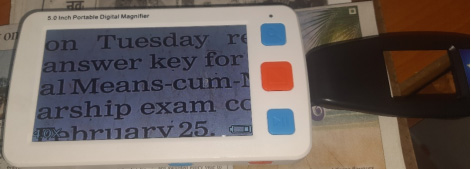
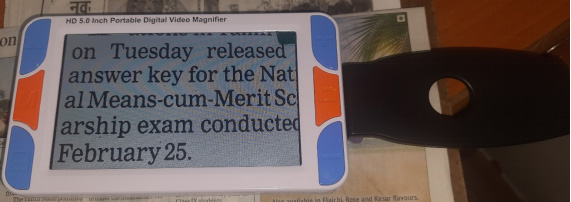
III. Portable CCTV (eg: Eye-Q) |
Visual enhancement Techniques:
| |
Head Scanning |
| |
Eccentric viewing |
| |
Visual tracking skills |
Referral done:
| |
Orientation and Mobility Training |
| |
Vocational training |
| |
Adjustment training (Daily living skills) |
| |
Early Intervention for children with Multiple disabilities |
| |
Special schooling |
| |
Disability certificate |
Available guidance (if necessary):
Contrast enhancements:
 |
| Poor contrast |
Better contrast |
Environmental modification to enhance contrast within the patients own living area are suggested so that their environment is suited to their visual limitations.
Independent Living Skills: Skills/techniques so that a person can carry out basic activities of Daily Living more independently in spite of visual impairment are discussed.
Disability Concessions: Details regarding Disability certificate and various concessions offered by the government for visual handicapped are provided. Various Concessions / monetary benefits available are also explained.
Availability of low-interest bank loans for visually impaired are informed
Visually impaired graduates are referred to various associations that help in providing placement for the visually impaired.
Assistive technology: Mobile software available for people with visual impairment are recommended for usage of mobile phones. Similarly there are various computer softwares available so that a person with visual impairment can use the computer independently. Appropriate software/basic computer modifications will be suggested based on the individual’s requirements.
Facilities for students: Students may be unable to perform well in regular school due to visual impairment. Appropriate magnifying devices to help them continue education will be suggested. The best mode of schooling (Regular / Integrated / Inclusive / Special) for the child to function well in spite of visual impairment will be recommended.
Details regarding use of an assistant such as a reader/scribe for students who are unable to perform well in exams due to visual impairment will be discussed.
For Further Information Contact:
Low vision care clinic
Sankara Nethralaya,
18, College Road, Nungambakkam,
Chennai - 600 006, Tamil Nadu, India
Phone: 044-42271519 / 044-28301519.
E-mail: lvc@snmail.org
|